Pesticide Residue: Chemical Analysis to Secure Food Chain Safety and Transparency

Using LC-MS/MS and GC-MS/MS to detect PFAS and neonicotinoids in foodstuffs
By Experts at Tentamus QTS Analytical (UKAS accredited testing laboratory No. 2640)
The testing of foodstuffs for pesticide and chemical residues is an essential part of food security. Due to the potential human health risks, there are stringent marketability requirements that must be met to ensure regulatory compliance. With around 500 approved pesticides used within the UK and EU, and legislation around their usage continually changing, the ability to monitor foodstuffs for chemical residues is a vital component of the food supply chain.
Maximum Residue Levels (MRLs): vital for regulatory compliance
The maximum residue level (MRL) is the "maximum concentration of a pesticide residue in or on food or feed of plant and animal origin that is legally tolerated when a plant protection product (PPP) is applied correctly (following good agricultural practice)” as defined by the Health and Safety Executive (UK).[1] However, applying PPPs is not only restricted to when the plants are growing. Post-harvest treatments and environmental exposure can also lead to chemical contamination, therefore residue analysis for chemical products applied during any part of the food chain is of critical importance.
It should be noted that, at the time of writing, MRLs do not apply to fish, or foods grown exclusively for animal feed.
Food analytical testing: both routine and targeted
Within the UK, designated Official Laboratories (OLs) undertake routine surveillance and monitoring of pesticide residues in food and animal feed on behalf of the UK Government – and imported foods must adhere to these standards too. In this work, fruit and vegetables, animal products, cereal products and infant food are all regularly analysed to ensure compliance with local regulations. As well as ensuring food safety, this testing is also important for upholding the public’s trust in the food supply chain.
However, in some cases targeted testing is necessary over-and-above routine surveillance, for example due to product contamination or public health concerns. In this case, analytical testing may require monitoring for a specific pesticide residue, often in response to a known regulatory alert or third-party whistleblowers.
Food testing: public concerns around PFAS and neonicotinoids
Within the analytical testing of foodstuffs, there are over 550 herbicides, fungicides and pesticides that need to be monitored, as well as their metabolites and degradation products. Of these, there are several compound classes that require more stringent monitoring, due to their environmental persistence, impact upon wildlife, or close media attention. For example, both per- and polyfluoroalkyl substances (PFAS) and neonicotinoids have received a great deal of media scrutiny in recent years, with the former due to their environmental persistence and the latter due to their impact upon pollinators, such as bees.[2]
PFAS ‘forever chemicals’ within the food chain
The presence of PFAS within the food supply chain is a hot topic, with numerous recent news stories and non-governmental organisations monitoring their presence. Analysis of the UK government's residue testing program [3] by Pesticide Action Network UK (PAN UK) revealed the presence of ten different PFAS pesticides in spices,[4] as well as various fruits and vegetables such as grapes, cherries, spinach, and tomatoes. While these materials have been deemed safe for public consumption in small quantities, close monitoring of contamination and distribution can help feed into other markers, such as environmental persistence or distribution.
The French Government has taken steps towards banning PFAS-based products across a range of products including clothing, cosmetics, and ski waxes, and the European Chemicals Agency (ECHA) is considering an EU-wide restriction of PFAS, which is anticipated for implementation in 2027. While pesticides such as fluopyram (1), a synthetic fungicide and nematicide, trifloxystrobin (2), a widely-used fungicide, and sulfoxaflor (3), a systemic insecticide, are currently exempt from restriction in France, this may change in future, Figure 1.[5]
Neonicotinoids and their impact upon pollinators
Neonicotinoids are another class of pesticide currently receiving close media scrutiny, and it could be argued that this attention has effected regulatory change: in January 2025 the UK government denied the use of neonicotinoid pesticide Cruiser SB (thiamethoxam) (4, Figure 1) on sugar beet for that year due to the concerns around toxicity towards pollinators, such as bees.[6] In this case, analytical testing was used to ensure compliance with local restrictions and laws by food producers.

Figure 1: Chemical structures of some commonly detected pesticides
High-precision chemical analysis for detecting trace residues of pesticides
Using analytical techniques to test for, and quantify, the presence of pesticides to both gather routine data and ensure that MRLs are not exceeded is a precise challenge. MRLs are usually in the mg/kg range, so the quantities likely present during testing will be in the micro-, nanogram or even femtogram range.[7] This means that the instrumentation used must be highly sensitive, as well as accurate – especially when millions of pounds worth of trade depends on it. The most commonly-used techniques for MRL determination are liquid chromatography-tandem mass spectrometry (LC-MS/MS) and gas chromatography-tandem mass spectrometry (GC-MS/MS), with both having detection limits within the required range. In general, LC-MS/MS is used for larger, less volatile compounds and GC-MS/MS for smaller, more volatile compounds.
LC-MS/MS and GC-MS/MS: stalwarts of analytical testing
In both LC-MS/MS and GC-MS/MS, samples are passed through a chromatography column – which reduces initial sample complexity through compound separation according to retention time – and the effluent is sent to the mass spectrometer, Figure 2. Within the mass spectrometer, there are two processes.
In the first stage, the molecules are ionised. For this process there are several different ionisation techniques available, which are broadly divided into “hard” and “soft” techniques:
· Hard techniques use higher energy and lead to more fragmentation of the parent molecule.
· Soft techniques use lower energy and lead to less fragmentation of the parent molecule.
The most commonly used techniques are EI (electron impact ionisation; hard), CI (chemical ionisation; soft) or ESI (electrospray ionisation; soft). GC-MS/MS typically uses a “hard” ionisation method and LC-MS/MS a “soft” ionisation method. The ions are then separated based on their mass-to-charge ratio (m/z).
In the second stage, ionised parent molecules are selected based on their m/z, discarding all other ions, and then subjected to a fragmentation process called collision-induced dissociation (CID), where the selected precursor ions collide with an inert gas. The m/z data of the resultant daughter ions are collected and analysed. The advantage of this approach is that even if the parent molecules have similar chromatographic behaviour, and they have the same mass-to-charge ratio, it is very likely that they will break into different daughter ions and thus be differentiated.

Figure 2: A simplified schematic or LC- or GC-MS/MS analysis.
GC-MS/MS in the detection of the PFAS fluopyram
An example of the instrument output is shown below, Figure 3(a). In this case, QTS Analytical — A Tentamus Company (UKAS accredited testing laboratory No. 2640), were commissioned to monitor for the presence of fluopyram (1) in a sample of soft fruit. Using GC-MS/MS, two instrument read-outs were given: the chromatogram, from GC, and the mass spectrum.
The chromatogram revealed that there were several species present in the original sample, which were separated during the GC stage and evidenced by peaks at different time-points, such as 12.55 minutes and 12.85 minutes (also called the retention time). These different peaks correspond to different fractions, where the original material underwent separation into its constituent parts. It’s these different fractions that were then subjected to first-stage and then second-stage ionisation within the mass spectrometer, and it’s the second ionisation that gives rise to the daughter fragments, which are shown.
Looking more closely at the data provided, the peak at 13.296 minutes contains a chemical compound with mass 396.0, corresponding to fluopyram (1), which, during the second ionisation event, was split into several fragments, including those with m/z 173.0 (5), 145.0 (6) and 223.0 (7), Figure 3(b). Overall, the total mass of materials under the chromatogram peak at 13.296 minutes correlate to a concentration of 0.21 mg/Kg, with the ion peak at m/z 173.0 (5) being the most abundant.
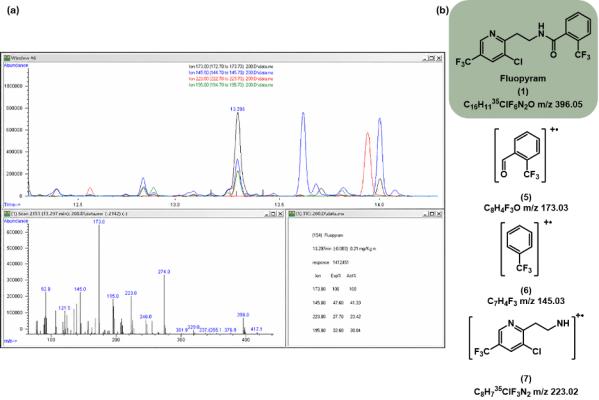
Figure 3: (a) GC chromatogram and tandem mass spectrometry data output for fluopyram (1); (b) postulated fragments for m/z 173.0 (5), 145.0 (6) and 223.0 (7).
Summary
In summary, the testing of pesticide residues on foodstuffs is of fundamental importance for ensuring food security and maintaining public trust in food supply systems. The use of highly specialised, highly sensitive instrumentation allows for detection of pesticides down to femtogram quantities. Our UKAS Accredited Pesticide Testing laboratory based in Kent, QTS Analytical — A Tentamus Company (UKAS accredited testing laboratory No. 2640), is an expert at delivering accurate testing results on fresh produce for British farmers and growers.
For further information about our analytical services, please reach out to us here!
FAQs
Is the use of mass spectrometry restricted to only pesticide residue testing?
No. Mass spectrometry can be used across a range of fields where highly accurate analytical data are required. Our family of Tentamus Companies can undertake mass spectrometry testing on a range of materials from a range of fields including water, cosmetics and pharmaceuticals. Contact us today to find out more.
Does Tentamus QTS Analytical hold any accreditations?
Yes, so you can be assured that the team are able to work to a high standard and produce reliable data. We hold a UKAS accreditation to ISO/IEC 17025:2017, testing laboratory No 2640.
References
[1] Maximum residue levels (MRLs) and import tolerances: Overview. Health and Safety Executive. https://www.hse.gov.uk/pesticides/mrls/index-overview.htm (Accessed March 2026)
[2] Perfluoroalkyl and Polyfluoroalkyl Substances (PFAS). National Institute of Environmental Health Sciences. https://www.niehs.nih.gov/health/topics/agents/pfc (Accessed March 2026)
[3] ‘Forever chemicals’ found in UK food. Pesticide Action Network, UK. 9th April, 2024. https://www.pan-uk.org/pfas-forever-chemicals/
[4] ‘Forever chemicals’ found in UK food. QTS Analytical – A Tentamus Company. https://www.qtsanalytical.co.uk/news/forever-chemicals-found-in-uk-food/ (Accessed March 2026)
[5] Toxic Harvest: Ban PFAS pesticides. Pesticide Action Network, UK. February 2024. https://www.pan-europe.info/resources/briefings/2024/02/toxic-harvest-PFAS-pesticides
[6] Pesticide emergency authorisation denied for 2025 to protect bees. UK Government. 23rd January 2025. https://www.gov.uk/government/news/pesticide-emergency-authorisation-denied-for-2025-to-protect-bees
[7] The GB MRL (Maximum Residue Level) Statutory Register. Health and Safety Executive. https://secure.pesticides.gov.uk/MRLs/Main (Accessed March 2026)